

Bitcoin mining is often seen by many as a symbol of high energy consumption. At the same time, the industry and researchers are increasingly arguing that mining can accelerate the energy transition. For context: During mining, specialized computers secure the Bitcoin network by providing computing power and confirming new blocks. New Bitcoins and transaction fees are generated as an incentive. You can find more basics here: What is Bitcoin Mining? Current data from the University of Cambridge shows: 52.4% of the electricity used globally for Bitcoin mining in 2025 comes from sustainable sources, of which 42.6% is from renewables and 9.8% from nuclear energy. Coal has fallen from 36.6% (2022) to 8.9% in the same period. What's behind this shift and how does mining fit into Europe's energy transition?
Current research on the energy mix
Cambridge Data 2025: 52.4% Sustainable Energy
The Cambridge Digital Mining Industry Report from the Cambridge Centre for Alternative Finance (CCAF) provides the most comprehensive analysis of the energy mix in Bitcoin mining to date:
Natural gas has thus replaced coal as the most important fossil source. A supplementary analysis of the Nodiens study "Mining the Future" projects the share of renewables to be at least 70 %.
How much electricity does the Bitcoin network consume?
Estimates vary depending on the methodology:
- Cambridge (CBECI): approximately 170–180 TWh per year in early 2026, about 0.7–0.8% of global electricity consumption.
- Digiconomist: approx. 204 TWh per year (maximum assumption).
For context: According to the Federal Ministry for Economic Affairs and Energy, Germany already covered over 55% of its electricity consumption from renewables.
Why this is relevant for the energy transition
Bitcoin Mining as a Flexible Load in the Power Grid
Mining facilities can ramp their power consumption up or down within minutes. This exact flexibility is lacking in many industrial operations. A review study in the journal Energy Conversion and Management (2026) explicitly classifies mining farms as "highly flexible loads" that can participate in Demand-Response Programs and contribute to grid stability.
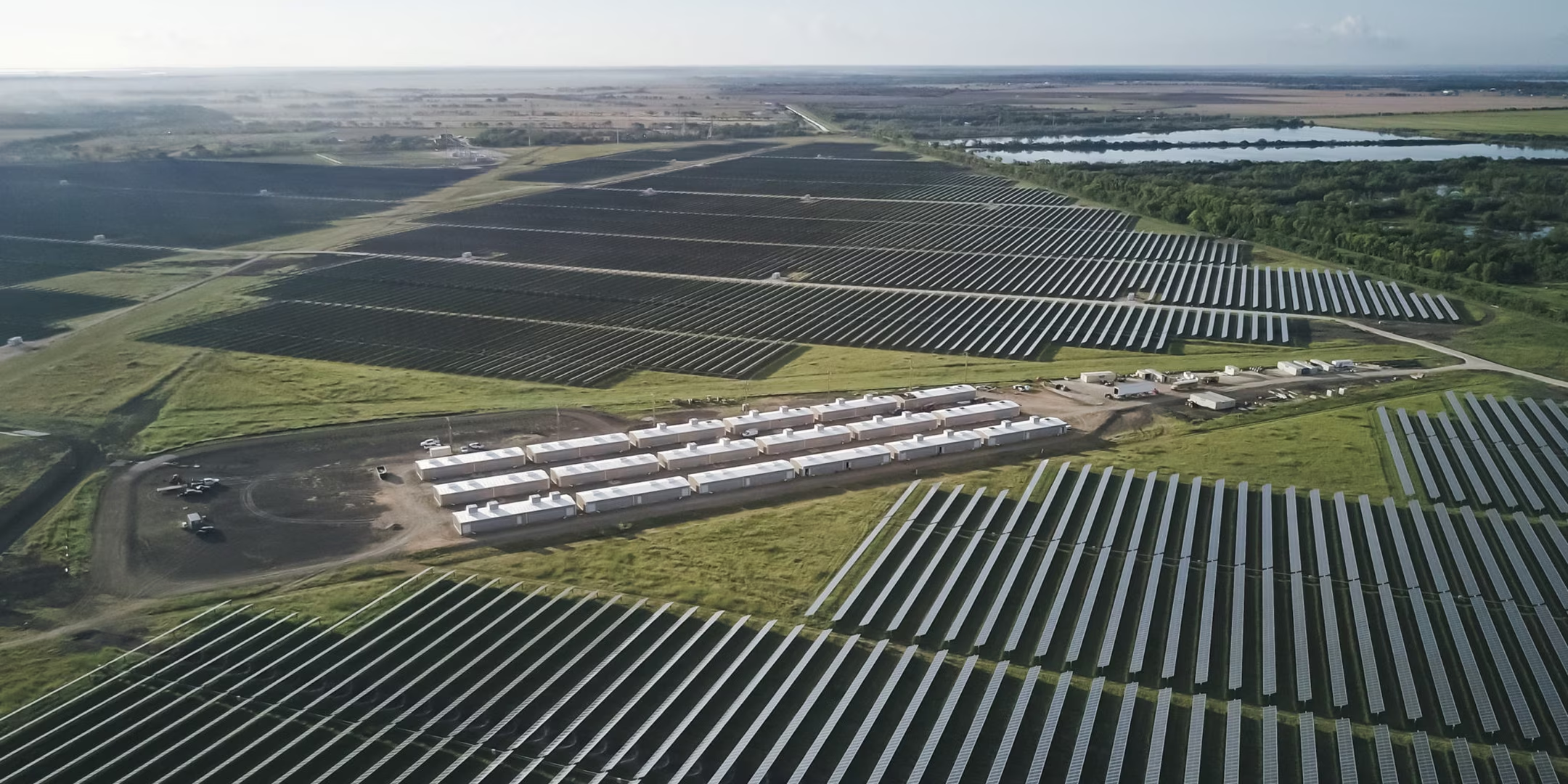
In Texas (ERCOT), this model is already a reality: Mining facilities reduce their consumption during peak loads and are compensated for it. Up to 10% of the revenue of a mining farm can, according to industry data, come from grid services.
Curtailed Power: Mining to Combat Curtailment
Wind and solar power plants often produce more electricity than the grid can absorb – they are "curtailed" (curtailment). In several countries, this rate exceeds 10% of potential generation. A study from Resource and Energy Economics (2023) shows: Mining can monetize curtailed renewable capacities and thereby make the expansion more economically attractive.
Methane Avoidance: Mining with Flare Gas and Landfill Gas
At oil and gas fields, excess natural gas is often flared – resulting in significant CO₂ and methane emissions. Over 20 years, methane is approximately 80 times more climate-damaging than CO₂. According to studies, mining containers that convert this gas into electricity on-site can reduce CO₂e emissions by up to 63 % compared to traditional flaring.
A similar model is being implemented at landfills: A study in the Journal of Cleaner Production (2024) shows how smaller landfills can become economically viable through Bitcoin mining to reduce methane emissions.
The Counterarguments – Where Mining Can Slow Down the Energy Transition
The discussion is not one-sided. A study by the University of Witten/Herdecke (2025) concludes that mining can accelerate the expansion of renewables in the short term, but delay the energy transition in the long term – for example, because mining revenues might make investments in grid infrastructure seem unnecessary.
The Bulletin of the Atomic Scientists also warns: As long as mining consumes surplus electricity, the economic incentive to transport this energy via power lines to high-demand regions decreases. In the USA, an analysis by the Congressional Research Service also points to risks such as e-waste, heat load, and noise near mining facilities.
The honest answer: Bitcoin mining is neither universally "green" nor universally "dirty." Location, energy mix, and business model are crucial.
What does this mean for Bitcoin users in Europe?
- Energy mix is improving: The share of clean energy in global mining has been rising for years: Bitcoin is becoming "greener" each year, without the protocol changing.
- Mining ≠ Holding or Saving: Anyone who buys, saves, or sends Bitcoin consumes no additional electricity. The energy consumption occurs during the mining process, not with individual user transactions.
- Regulatory Framework: In the EU context (MiCA), the focus is on sustainability disclosure requirements for crypto service providers, not mining bans.
Conclusion
Bitcoin mining and the energy transition are not necessarily contradictory. Current data shows a clear trend towards more sustainable energy sources, and mining can play meaningful roles in the energy system as a flexible load, consumer of surplus electricity, and methane utilizer. At the same time, regulatory guardrails and transparent reporting are necessary so that electricity consumption does not hinder grid expansion. Those who use Bitcoin as a long-term savings tool benefit from precisely this development – without consuming additional energy themselves.
Frequently Asked Questions (FAQ)
How much electricity does Bitcoin consume per year?
According to Cambridge CBECI, around 170–180 TWh – approximately 0.7–0.8% of global electricity consumption (as of early 2026).
What is the share of renewables in Bitcoin mining?
The latest Cambridge study cites 42.6% renewables plus 9.8% nuclear energy – totaling 52.4% sustainable sources.
Does mining truly help with the expansion of renewables?
Several studies show that mining can make curtailed electricity usable and make investments in wind and solar projects more economical. However, critical voices warn against long-term lock-in effects.
Does every Bitcoin transaction increase electricity consumption?
No. Consumption is tied to mining (securing the network), not to individual transactions.
Note: Marketing communication from FIOR Digital GmbH (21bitcoin). Investments in Bitcoin are associated with risks and opportunities. Past performance is not an indicator of future developments. This article does not constitute legal or investment advice.