


When buying Bitcoin, you have to make a fundamental decision: should the Bitcoin be stored in your own wallet or held by a specialized provider? With self-custody you control the private keys yourself. With third-party custody a service provider takes care of the technical security and management of the keys.
The short answer to the security question is: Neither model is inherently safer. Self-custody reduces the risk associated with a provider, but shifts the entire responsibility onto you. Third-party custody is more convenient and can offer professional security processes, but it introduces counterparty risk.
Self-custody or third-party custody: the most important difference
Bitcoin are not stored like files in an app or on a hardware device. They remain as entries on the Bitcoin network. A wallet manages the cryptographic keys that allow you to access the associated Bitcoin.
The decisive question is therefore: Who controls the private key?
- Self-custody: You control the keys yourself.
- Third-party custody: A provider controls and protects the keys on your behalf.
The well-known phrase "Not your keys, not your coins" sums up the advantage of self-custody. However, it doesn't cover the entire trade-off: those who hold their own keys must also reliably protect them against loss, theft, and user error.
What does Bitcoin self-custody mean?
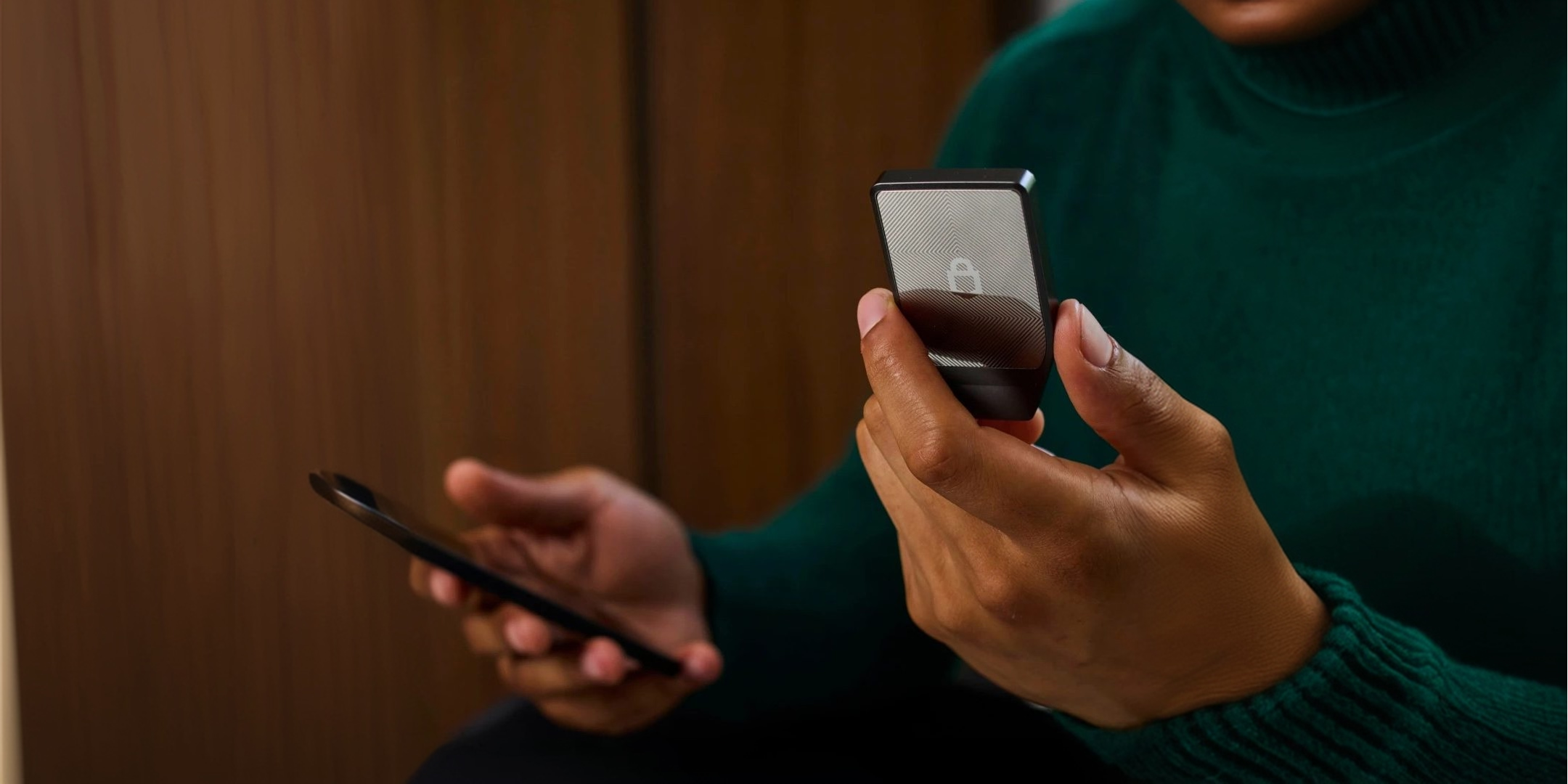
With self-custody, you use a non-custodial wallet. This can be a software wallet on your smartphone or a hardware wallet that manages keys in an isolated environment. You can sign transactions yourself without needing a company to authorize them for you.
When setting it up, you receive a backup depending on the wallet, usually in the form of a Seed Phrase consisting of 12 or 24 words. This backup allows you to restore access to your wallet. Anyone who knows the seed phrase can generally access and control the Bitcoin. Therefore, it should never be photographed, stored in the cloud, or shared with anyone else.
Benefits of self-custody
The biggest advantage of self-custody is full control: You do not rely on a provider's approval and can receive or send Bitcoin directly via the network. At the same time, counterparty risk is reduced because a custodian's insolvency or operational failure does not directly affect your own wallet. In this way, self-custody aligns with the decentralized core principles of Bitcoin and enables a high degree of financial sovereignty.
Risks of self-custody
Full control comes with significant personal responsibility. If your seed phrase and access are lost, there is no password reset function, and no one can recover the wallet for you. If the seed phrase falls into the wrong hands through theft or phishing, the associated Bitcoin can be stolen. Legitimate support staff will therefore never ask for your recovery words.
Operational and backup errors can also have serious consequences. Confirmed Bitcoin transactions cannot simply be reversed. Fire, water damage, theft, or unclear estate planning can also jeopardize future access. Wallet selection, updates, test transactions, and secure storage are entirely up to you.
Hardware wallets are frequently used for larger amounts and long-term storage. They reduce the risk of malware on a connected computer or smartphone accessing the key directly. However, even a hardware wallet does not protect against a compromised seed phrase or a poorly planned backup.
What is third-party Bitcoin custody?
With third-party custody, a company manages the private keys on behalf of its customers. Access is usually provided via an account or an app. Security measures such as two-factor authentication protect the account, while the provider operates the key infrastructure.
In the EU, the Markets in Crypto-Assets Regulation (MiCA or MiCAR) establishes uniform rules for crypto-asset service providers. This includes requirements for authorization, organization, transparency, and supervision. Regulation reduces risks but does not eliminate them entirely. Users should continue to verify how a provider stores Bitcoin, whether withdrawals are possible, and what conditions apply to insurance coverage.
Benefits of third-party custody
Third-party custody primarily makes getting started easier: you do not need to manage a seed phrase or your own wallet backup. If you lose your smartphone or password, a formal process can restore account access. Reputable providers also combine professional infrastructure, such as cold storage and access controls, with organizational security processes. This allows buying, selling, storing, and sending to be conveniently bundled in one application. Additionally, a support team is available for technical or organizational questions.
Risks of third-party custody
With third-party custody, a counterparty risk remains: you are dependent on the security, liquidity, and reliability of the provider. Since you do not directly control the keys, transactions are technically facilitated by the custodian and may be subject to review. Centrally managed systems are also an attractive target for attacks.
Withdrawals may be delayed due to security checks, maintenance, or legal requirements. Protection promises should also be read carefully: insurance usually only applies to clearly defined cases of loss and is not equivalent to state-backed deposit insurance.
Bitcoin self-custody vs. third-party custody compared
Which Bitcoin custody option is right for you?
The right solution depends not only on the amount, but also on your experience, security knowledge, and personal risk assessment.
Self-custody might be right for you if you …
have understood how wallets and backups work and can store your seed phrase securely for the long term. You should also be prepared to take responsibility for test transactions, updates, and the long-term recoverability of your wallet. In return, you can access your Bitcoin independently of any provider.
Third-party custody might be right for you if you …
- are just starting out with Bitcoin,
- do not have a secure process for managing a seed phrase,
- value account recovery and personal support,
- use a regulated provider with a transparent custody concept.
Important: A small balance can be suitable for learning self-custody with a test transaction first. Anyone setting up their own wallet should understand the recovery process before transferring larger amounts. The seed phrase should never be entered on a website and never sent to support staff.
Why not combine both custody models?
Self-custody and third-party custody are not mutually exclusive. One possible strategy is to buy Bitcoin from a regulated provider and transfer it to your own wallet once it accumulates. This allows you to combine the convenience of purchasing with the control of your own keys.
At 21bitcoin, you can decide for yourself how you want to store your Bitcoin. If they remain in your 21bitcoin account, technical custody is handled via BitGo Custody's cold storage infrastructure. According to 21bitcoin, the custodian holds an insurance policy of up to 250 million US dollars; the respective terms and covered loss events apply.
Alternatively, you can send Bitcoin to an external wallet or use the auto-wallet transfer feature. You set a threshold at which your purchased Bitcoin are automatically transferred. If you want to transfer purchases directly into your own custody, you can also connect 21bitcoin to your own wallet.
According to the company, 21bitcoin is authorized by the Austrian Financial Market Authority as a crypto asset service provider under MiCAR. Regulation, professional custody, and the option to use your own wallet give users the freedom to adapt the model to their own level of expertise.
Checklist: What to look out for in custody
For self-custody
- Only download your wallet from an official source.
- Store your seed phrase exclusively offline and protect it from unauthorized access.
- Do not take photos of your seed phrase or save it to the cloud.
- Verify the receiving address in full before sending.
- Perform a small test transaction first.
- Plan for recovery and inheritance.
For third-party custody
- Check the regulatory status and the company responsible.
- Read up on how the Bitcoin is technically stored.
- Enable two-factor authentication.
- Understand the terms for withdrawals and insurance.
- Verify that Bitcoin can be sent to your own wallet at any time.
- Be aware of phishing and use only official communication channels.
Conclusion: Control and responsibility go hand in hand
Self-custody offers maximum independence but requires a robust security and backup process. Third-party custody reduces technical effort and provides support, but requires trust in a provider.
The best solution is therefore not automatically the most technically advanced one. It is the one whose risks you understand and can reliably manage. If you want to learn self-custody, start small. If you use a custodian, look for regulation, transparent security processes, and the ability to withdraw freely to your own wallet.
FAQ
Which is safer: self-custody or third-party custody?
That depends on how it is implemented. A carefully set up hardware wallet can reduce counterparty risk. A professional custodian can help prevent user error and provide regulated security processes. Both become insecure if basic protective measures are missing.
Are Bitcoin stored on a hardware wallet?
No. Bitcoin remain on the Bitcoin network. The hardware wallet protects your private keys and signs transactions without exposing the keys unnecessarily.
What happens if I lose my hardware wallet?
With a properly secured wallet backup, you can restore access on a compatible device. Without a backup, access may be permanently lost.
Can a provider freeze my Bitcoin?
With third-party custody, access can be affected by security checks, legal requirements, or account restrictions. With self-custody, you control your transactions yourself as long as you have access to your keys.
Is insurance the same as deposit protection?
No. Bitcoin are not covered by standard government deposit protection schemes for bank balances. Insurance provided by custodians only applies to the extent defined in the contract.
Do I have to commit to one model permanently?
No. You can combine custody methods or switch later. The key is to prepare transfers carefully and test the destination wallet beforehand.
Note: Marketing communication from FIOR Digital GmbH (21bitcoin). Investments in Bitcoin involve risks and opportunities. Past performance is not an indicator of future results. This article does not constitute legal or investment advice.